Wednesday, April 18, 2012

Shatterproof Glass


Sorry for the long silence. Excuses, NYC burnout, confusion, purpose-turning and scrivening, as ever. At first I thought I'd blog about the Chris Hedges controversy, my recreational reading on the plane back to Madrid last month. The war correspondent and OWS symp Hedges attacked the Occupy movement's “diversity of tactics” as an excuse for “violence” by anarchist elements, which he called the “cancer in the Occupy movement.” Of course I think Hedges is packing baloney – people have to assert their rights or they won't have them, including their right to the city. Still, I decided not to blog on this. The text provoked a lot of responses, though, so my comment became superfluous aside from compilation. I refer you to David Graeber's excellent response, the thoughtful rejoinder by Crimethinc and the new Fifth Estate. For the rest, Google will do it.
Oh no, I can't help it! The controversy points to the divide between reformists and anti-systemists within the Occupy movement. I don't want to say “revolutionaries,” although it's crystal clear that we cannot go on like this. (Anti-establishmentarians?) And it would be just as foolish to call the reformists the “rot within the Occupy movement.” Everyone needs to be in on this. Tom Hayden stands with the latter camp as he turns 70. (The Port Huron-era SDS just had a reunion convergence at NYU.) He put the current Occupy movement in context with the Civil rights struggle recently, remarking on occupation as a tactic: “The logic of an occupation, I think, is that if you feel voiceless about a burning issue of great great importance, and the institutions have failed you, the only way to get leverage for your voice is to occupy their space in order to get their attention” (Speaking to Amy Goodman on Democracy Now, April 13, 2012).
In March at the SQEK/House Magic library show at Interference Archive in Brooklyn, Adrien from Les Cafards in Paris showed films and gave a talk in March. He spoke about “France under global debt threat, seen from a suburb, in between squatted houses, political issues, housing, money and social problems, everyday life, autonomous struggles, and dreams to occupy the entire city.... about sharing some questions and tensions inside social movements outside institutional politics, and inside a small community of activists mostly living in squatted houses in an eastern suburb of Paris. “With some successes and failures, we try to organize to keep away monetary necessities, stupid jobs, part-time contracts, economic pressure. We reach for a bit more freedom, more time, and somehow, by any means we can find, take down the capitalist system. We try to fight against huge urban projects, housing evictions, police practices—in order to build community forces against the crushing metropolis. We try to open and defend spaces for organizations, a social center (for example) in which we can have meetings, meals, shows, and where we can meet, share our situations, our problems, to sort out collectively our pressures and problems.” I see that his bunch is meeting this month at a coffe shop near Metro Robespierre. Great traditions never die!
Another SQEK New York participant who is still hanging around the Big Apple is Nathan Eisenstadt, Last weekend he workshopped at the New York Anarchist Book Fair on the story of his group, Bristol Space Invaders. That is a “UK based collective that emerged after an international call-out for days of action in defence of squats and autonomous spaces in 2008. Since its inception the group have been responsible for a range of temporary spectacular event-spaces from large urban convergence centres for particular actions/struggles/gatherings to illicit theatrical speakeasies, high-grade free restaurants, art galleries, squatter-estate agents and finally a more permanent space: the Factory, a huge squatted Social Centre in Bristol, England” (evicted November 2011). Nathan sounds like a swell resource for local creative activists! Wearing his other hat, the Bristol-based geographer who an academic talk tomorrow as a “participant/ethnographer of autonomous spaces” to the Space Time Research Collective, a new student group at the CUNY Graduate Center.
MEANwhile, “House Magic” journal #4 is available for PDF download at the website, https://sites.google.com/site/housemagicbfc/. It's really good! And #5 is going to be an assembling – it's an open call. I'm going to try and close it in time for summer. Here's what is in the #4 zine of the “House Magic: Bureau of Foreign Correspondence” project: the bulletin of the information project on squatted spaces and social centers includes many squats launched by the U.S. and European Occupy movements – 44 pages of occupation information and history, in articles and short blurbs. Features: Aja Waalwijk on Ruigoord, an old-time Dutch squatted village, and Rob Robinson of O4O and Picture the Homeless in NYC on international solidarities.
Table of Contents – pages of bulletins, including Occupy London's “Bank of Ideas”; the attempt to make a social center in Chapel Hill, North Carolina; and again in Seattle, Washington; a huge collage from the Ungdomshuset cafeteria in Copenhagen; Libertad Guerra's collage celebrating the CHARAS group's work in 1970s Loisaida, NYC; sculptor Ken Hiratsuka's stone commemorating an evicted garden; the program of the Berlin 30 year squat anniversary celebration; a digest of the anti-gentrification work going on in Hamburg; the story of anarchist organizing and the AK57 in Budapest and a travelogue on a “political business trip” to London; an extensive text on the squatted village of Ruigoord, which celebrates its anniversary this year; the story of the legalized Tabacalera in Madrid; and an interview with homeless advocate Rob Robinson on NYC's O4O and its solidarities in Africa and Brazil.
My text, “This Show Brought To You By The Squatting Movement” is up at the NY Arts magazine website as part of their spring issue. I also just finished a draft of a talk, “Art + Squat = X” for a talk Universidad Complutense in Madrid, where I am a visiting researcher. When it's decent, I'll upload it to the website, where the predecessor texts are also sitting.

LINKS

Adrien from Les Cafards at Interference Archive, SQEK/House Magic library
http://interferencearchive.org/#19299212350
Cockroach coffee klatch, April '12 – CAFé des CAFards au Rémouleur
http://paris.indymedia.org/spip.php?article10524

New York Anarchist Bookfair workshop schedule (April 15-16, 2012)
http://anarchistbookfair.net/node/71

http://anarchistbookfair.net/
Anarchist Book Fair last weekend (although the arts festival continues, April 21-22).
(Breaking news -- I see there was some rioting after – http://www.nydailynews.com/new-york/pipe-wielding-anarchists-attempt-shatter-floor-to-ceiling-plexiglas-windows-east-village-starbucks-article-1.1062125 – at least the AFB got the chance to disassociate themselves in the press. Starbucks was ready for them, with shatterproof windows. I only wonder why didn't do something useful and try to kraak a social center? )

Nate Eisenstadt
http://www.bris.ac.uk/geography/people/nathan-eisenstadt/index.html

Factory, evicted November 2011
http://freefactory.wordpress.com/

House Magic #4, Spring 2012 – download it! print it! sell it!
https://sites.google.com/site/housemagicbfc/

Alan W. Moore, "This Show Brought To You By The Squatting Movement," NY Arts, Spring 2012
http://www.nyartsmagazine.com/reviewed/this-show-brought-to-you-by-the-squatting-movement

poster from the 2009 NYC Anarchist Book Fair by Josh MacPhee

Tuesday, March 27, 2012

Recent Texts Posted Elsewhere Online


Still sifting through the mass of materials that came to light at the SQEK events in New York City this February. Some accounts of our adventures have already appeared online:
Miguel A. Martínez, “Tras las huellas de las okupaciones en New York City (1): ABC No Rio”
Notes about about ABC No Rio in Spanish, with some excerpts in English. March 2, 2012.
http://www.miguelangelmartinez.net/?Tras-las-huellas-de-las&var_mode=calcul
Miguel A. Martínez, “Tras las huellas de las okupaciones en New York City (2): Legalizaciones en Loisaida”
Notes on legalization of squats in NYC, in Spanish with some quotations in English, among them an interview with Frank Morales. March 3, 2012.
http://www.miguelangelmartinez.net/?Tras-las-huellas-de-las,180&var_mode=calcul
Elisabeth Lorenzi, “Memory of Reclaimed Urban Space in New York”
Posted on March 22, 2012 to Periferies Urbanes, blog of Grup de treball de l'Institut Català d'Antropologia
http://periferiesurbanes.org/?lang=en [also in Spanish, Italian, Catalan]
Also, we have just uploaded to N+1 SQEK website the following document: “AAG session abstracts for February 2012 SQEK-organized sessions”. This is all the published abstracts for the sessions organized for SQEK at the Association of American Geographers Annual Meeting in New York City, Friday, 24 February, 2012. The sessions were entitled “Squatting and Social Centers: Resistance and Production of Critical Spaces” (5 sessions, 8am-6:20pm). All abstracts were culled from the AAG conference website.
https://n-1.cc/pg/file/owner/group:91603

Photo: Steven Englander, director of ABC No Rio, in front of the building talking to SQEK members. Next to him is Matt Metzgar, organizer of the Squatter Rights Archive at Tamiment Library. Photo by Miguel Martinez.

Sunday, March 4, 2012

“Army of Euro-Squatters Invade NYC” – Mission Accomplished


The SQEK 2012 New York City conference is now concluded. During an intense five days of lectures, talks and discussions with academics, activists and an interested public, New Yorkers learned the facts about political squatting, the big building occupations called social centers, and the political and cultural differences in squatting conditions between European countries. Part of the standout event, an hour and a half meeting with SQEK researchers at the Living Theatre, has already been mounted to the web by Sebastian Gutierrez. Sebastian was the producer of the “Squats, Social Centers and Autonomous Spaces” panel at last year's Anarchist Bookfair in NYC, which is also on YouTube.
Our week began last Thursday, February 23rd, with a reception at ABC No Rio. There we met our hosts, Lower East Side squatters like Steven Englander, Matt Metzgar and Bill Di Paola, all of whom are still activists in the neighborhood. We were also greeted by artist sympathizers like Rebecca Howland, Ann Messner, Peter Fend and Tom Otterness. Matt and Bill later led many SQEKers on tours of the squats, most now legalized as low income cooperatives. Miguel Martinez has already written about these visits and the NYC squatter movement in two texts on his blog, “Tras las huellas de las okupaciones en New York City” (in the footsteps of the NYC squatters), at miguelangelmartinez.net. Miguel writes in Spanish, but includes numerous photos and some original movement texts in English.
The next day we spent in a conference room at the Hilton, doing a day-long special session. It was called “Squatting and Social Centers: Resistance and Production of Critical Spaces” for the American Association of Geographers convention. (You can hunt down the abstracts of the papers from the URL below.) These sessions were very interesting, and the room was frequently packed. Numerous other researchers interested in squatting also participated, among them once-imprisoned German gentrification expert Andrej Holm.
The next day we relaxed at the Remedy coffeeshop downtown in the morning, and then trotted to the Living Theatre to talk. I was especially pleased that we could talk there, since Judith Malina is such an important figure in anarchist culture. She and the late Julian Beck were also, appropriately enough, prominent in the occupation of the Théâtre de l'Odéon during the May 1968 uprising in Paris. SQEK was sandwiched in between a play about nurses in Vietnam, and the final performance of Judith's own anti-war epic, “History of the World.” We passed the red jar, and raised some money for the perpetually under-funded Living.
The next day we were set to talk at 16 Beaver Group in a more intimate circle. On my way downtown I stopped off in Tompkins Square Park, where some folks were gathering for an afternoon of left-centric events. Drums were booming, clowns were prancing – this was a “Pop-up Town Square,” the first of numerous “mobile, daytime occupations” which are promised in NYC over the next few months. This is an OWS-related Facebook-driven project, and looks to be a try-out zone for a lot of interesting activist manifestations. If that sounds vague, well, that's kind of the modus operandi here. “It's a surprise.” Still I saw some old friends, like Wendy Brawer of the Green Map project, and Alexis Bhagat, sonic geographer extraordinaire, and gathered up an armful of leaflets, including a glossy printed OWS projects list. Much scheming is afoot, and longing gazes have been turning towards the huge bulk of the El Bohio building on 9th Street, the ten-years-vacant neighborhood social center.
I didn't catch a lot of the talk at 16 Beaver, since I was cooking spaghetti with my son Taylor! But one of the SQEKers remarked later to me that he was glad to hear members of our group relate personal tales and anecdotes, rather than discourse academically. We wandered off when our time was done, but the evening saw members of the Occupied London collective talk at 16 Beaver. Their work is an invaluable source of counter-information on the Greek struggle against the austerities. Occupied London published a magazine at one point, and I cribbed a number of their marvelous graphics for “House Magic” exhibition wallpaper.
In the evening we met nearby with the O4O group, Organizing for Occupation, which is allied with the homeless advocacy group Picture the Homeless and Take Back the Land. This is the group that has been doing foreclosure defense in NYC, interrupting auctions by singing the original ballad “Mr. Auctioneer” (see the videos), and generally raising the ruckus of a political squatting movement in the USA. SQEKers and friends heard about the legislative and direct action strategies that PtH and O4O have been pursuing, in partnership with the growing national Take Back the Land movement. Rob Robinson, Frank Morales and others impressed us with their determination, and passed around their latest accomplishment – a handsomely printed report, “Banking on Vacancy: Homelessness and Real Estate Speculation” (PDF online). This document reflected the work of volunteers doing a count of vacant housing in NYC, showing that just a third of this vacant stock could house all of the city's homeless. It hasn't happened, we're told, because of the fabulous profits that cronies of the city government receive from the homeless shelter system. SQEKers enthusiastically agreed this is a strategy that could work in their towns.
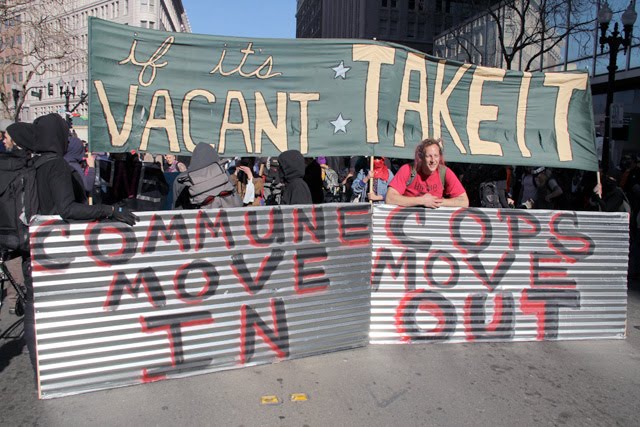
The next day we spent at the Graduate Center, City University of New York, talking wiith students and others at a research seminar and then another public presentation in the evening. That talk was sponsored by the Center for Place, Culture and Politics, and arranged by oral historian Amy Staracheski. That afternoon we missed a chance to Skype chat about the Oakland Commune's attempt to establish a social center earlier this year. Brandon Jourdan made a film about it – but a spokesperson for the group who was in town could not make it that day, and the SQEKers decided to pass on this talk. I posted a text by the Oakland Commune in this blog earlier, and I strongly recommend Brandon's films. This was an important action, expensive for the participants, but hopefully prescient, and Brandon is one of a handful of journalists who is following the global new '68.
Finally, Friday night also saw a reception and splendid exhibition at the Interference Archive in Brooklyn. The archive made a near last-minute decision to mount their own materials about squatting in Europe – brilliant colorful posters and long shelves of books and zines – together with the research collection of my own “House Magic” project. SQEK members arrived exhausted after the all-day panel sessions, but the “SQEK Library” continues at Interference Archive, as a 2012 “footprint” of the conference. On Tuesday after the conference, several of us went along to a conference at NYU for the East Village Other, the famous underground newspaper of the 1960s. I jumped up in question time (about 1:16 of the tape) and asked the panelists if they had any recollections of political squatting, big building occupations, and communes in the East Village during the 1960s? (I knew of these only from Samuel R. Delany's book “Heavenly Breakfast” of 1979.) After the talk, as we scarfed up NYU's sandwiches and wine, a woman named Lola Cohen told me of a Dutchman, Steef Davidson, editor of the “Kabouter Kernel” in Amsterdam, who had lived in the neighborhood in the 1960s. This moves the horizon of Dutch New York City squatting interchange back a couple decades! That night the remaining SQEKers met for the last time to watch Matt Metzgar's band perform at a local bar. Bill Di Paola gave us all hats for the newly launched Museum of Reclaimed Urban Spaces, and we kissed goodbye.
Everyone enjoyed these events with their unusual mixture of activists and academics. For me, this conference event and archive installation completes the work of the “House Magic” project. My intention was to introduce the European movement of political squatting and big-building occupations called social centers to the U.S. public. That work is definitively done. What's next? Well, there's the work of processing and digestion after this conference. But “House Magic” is going to have to turn a corner. We'll see what lies ahead.

Photo: SQEKers visit the Interference Library exhibition. Left to right, IA collective members Molly Fair (inclined head), Kevin Caplicki (with camera) and Josh MacPhee (in red hoodie); NYC SQEK organizer Amy Staracheski (with baby).

LINKS //////////////////////

Sebastian Gutierrez, “SQEK I [II & III] – Squatting Europe Collective” on YouTube

Miguel on our visit to ABC No Rio
http://www.miguelangelmartinez.net/?Tras-las-huellas-de-las&var_mode=calcul

Session at the AAG: “Squatting and Social Centers: Resistance and Production of Critical Spaces”
http://meridian.aag.org/callforpapers/program/SessionDetail.cfm?SessionID=13799&cal=true
(This is only abstracts of the morning session, “I” – follow the dots to the rest of 'em.)

Occupy Town Square
http://www.facebook.com/occupytownsq

16 Beaver Group, “Two Events - Two Collectives - Squat, Strike, Occupy, and Write To Tell All”
http://www.16beavergroup.org/02.26.12.htm

On the Greek Riots - Occupied London: Offers irregular updates and articles on the situation in Greece.
www.occupiedlondon.org/blog/

Picture the Homeless, “Banking on Vacancy” PDF and description
http://picturethehomeless.org/vacancycount.html

Center for Place, Culture and Politics at CUNY-GC
http://pcp.gc.cuny.edu/

Brandon Jourdan's short films “Battle of Oakland,” and “Oakland Commune”
http://brandonjourdan.blogspot.com/

Interference Archive SQEK library
http://interferencearchive.org/post/18169750438/sqek-library-a-collaboration-between-squatting

“Blowing Minds: The East Village Other” panel discussion
http://eastvillageother.org/media

Museum of Reclaimed Urban Space
http://www.morusnyc.org/

Monday, February 6, 2012

SQEK Coming to NYC February 23-27


Yes, the Squatting Europe Kollective is meeting in New York this month. We're hoping to be historic.
The schedule is posted at: http://sites.google.com/site/housemagicbfc/sqek-nyc-feb-12-schedule
And pasted here:
SQEK NYC 2012 description LITTLE

Squatting Europe Collective, New York City, February 23-27, 2012
1. Press release
2. Reception, Thursday 2/23 at ABC No Rio, 7-10pm
3. AAG sessions, Friday 2/24 at Hilton Hotel, 2nd floor Nassau Room
4. Saturday, February 25th, afternoon/evening – Public presentation: “Squatting in Europe: Prospects and Perspectives” at Living Theatre, 5-7pm; ends sharp
5. Sunday, February 26th – brunch meeting at 16 Beaver Group 12-4pm // meet with O4O group at 7pm
6. Monday, February 27th – Public meetings with activists TBA // Presentation at CUNY-GC 6:30-8:30pm

7. SQEK “Living Library” at Interference Archive, Brooklyn

8. AAG session description (theoretical questions around militant research)


Squatting Europe Kollective Convenes in New York City

For the first time ever, a group of activist researchers from the European squatting movement are gathering in New York City. They will make public appearances to speak about the decades-old movement of squatting and building occupations in their respective countries.

The tradition of political squatting is moving from the shadows into the light. With the world-wide rise of the Occupy movement, the deep reservoir of experience within the movements of political squatting have become suddenly significant.

Generations of activists have participated in occupations of vacant buildings in Europe, beginning in the 1970s. The best known early success was the famous “free city” of Christiania in Copenhagen. But every major city in Europe has experienced some version of politicized squatting, most recently in the form of social centers.

The members of SQEK – Squatting Europe Collective – have gathered for special sessions at the Association of Amerian Geographers' annual convention February 24. A public discussion, meetings, film and graphic arts exhibition are among the other activities planned for the meeting,

Scheduled activities for SQEK 2012 New York City:

2. Reception, Thursday 2/23 at ABC No Rio, 7-10pm

Thursday, February 23rd 7-10 pm – Reception for visiting researchers and activists
poster show of “House Magic” zine about squats and social centers
ABC No Rio cultural center
156 Rivington Street
Loisaida, NYC // abcnorio.org


3. AAG sessions, Friday 2/24 at Hilton Hotel

Squatting and Social Centers: Resistance and Production of Critical Spaces I
(5 sessions, 8am-6:20pm) in Nassau A, Second Floor, Hilton NY
Note: Single session costs a lot of money, but you can probably sneak into this room which we have all day. Look like you belong there; it will be a radical egghead party...
8:00 AM - 9:40 AM – Participants: Miguel A. Martinez (University Complutense of Madrid/CSOA Casablanca) and Lucy Finchett-Maddock (University of Exeter), Pierpaolo Mudu (University of Rome/Forte Prenestino), Hans Pruijt (Erasmus Universiteit, Rotterdam), Loredana Guerrieri (Osservatorio Di Genere, Istituto Storico Della Resistenza, Macerata, Italy), Matthias Bernt (Leibniz Institute for Regional Development and Structural Planning, Leipzig)

10:00 AM - 11:40 AM – Participants: Linus Owens (Middlebury College, Vermont), Nathan Eisenstadt (Bristol University), Giovanni Piazza with Valentina Genovese (University of Catania), Alessia Marini (University of Rome, La Sapienza), Matthias Bernt

2:40 PM - 2:20 PM – Participants:Elisabeth Lorenzi (UNED Universidad Nacional de Educación a Distancia), Amy Starecheski (CUNY City University of New York, Graduate Center, New York), Thomas Aguilera (Sciences Po, Paris), Andrea Aureli (St. John's University, Rome), Matthias Bernt

2:40 PM - 4:20 PM Panel session; Participants: Justus Uitermark (Erasmus University, Rotterdam); Maria Rodó de Zárate (UAB Universitat Autònoma de Barcelona); Giovanni Piazza; Miguel A. Martinez; Thomas Aguilera; Amy Starecheski; Hans Pruijt; Andrea Aureli; Eliot Tretter (University of Texas, Austin)

4:40 PM - 6:20 – Mark Purcell (University of Washington, Seattle); Eli Meyerhoff (University of Minnesota); Pierpaolo Mudu; Lucy Finchett-Maddock; Nathan Eisenstadt; Alessia Marini; Loredana Guerrieri; Elisabeth Lorenzi; Salvatore Engel-DiMauro (SUNY State University of New York, New Paltz)

4. Saturday, February 25th – SQEK internal meeting 9am-12pm – City University of New York, Graduate Center student lounge, 34th St. & 5th Ave., 5th floor (tentatively confirmed)

5. Saturday, February 25th, afternoon/evening – Public presentation: “Squatting in Europe: Prospects and Perspectives” (Living Theatre, 21 Clinton St half a block below Houston Street, 5-7pm; ends on the dot of 7pm)
Public presentation by members of the Squatting Europe Collective (SQEK)
“Squatting in Europe: Prospects and Perspectives”
A roundtable with the members of SQEK
Generations of activists have participated in occupations of vacant buildings in Europe, beginning in the 1970s. The best known early success was the famous “free city” of Christiania in an abandoned military base in Copenhagen. By now nearly every major city in Europe has experienced some version of politicized squatting. Often this takes the form of the social center, occupations of large buildings which are organized to provide cultural, political and social services, usually for free.
For the first time ever, a group of activist researchers from the European squatting movement are gathering in New York City. They will make public appearances to speak about the decades-old movement of squatting and building occupations in their respective countries.
The tradition of political squatting is moving from the shadows into the light. With the world-wide rise of the Occupy movement, the deep reservoir of experience within the movements of political squatting have become suddenly significant.
Confirmed participants in a roundtable public presentation are: Miguel Martinez, Elisabeth Lorenzi (Madrid, Spain), Hans Pruijt (Rotterdam, Netherlands), Gianni Piazza (Sicily), Eliseo Fucolti (Rome, Italy), Thomas Aguilera (Paris, France), Lucy Finchett-Maddock (United Kingdom), Lynn Owens, Tina Steiger (Copenhagen/USA), Alan W. Moore (Madrid/USA)

6. Sunday, February 26th – Public meetings with activists
noon-4pm – brunch and afternoon session at 16 Beaver Group, 16 Beaver St., Wall St. area (tentatively confirmed)
7pm – Catholic Worker auditorium (55 East Third St.) – a round table, “talking turkey” with activists of O4O (Organizing for Occupation)

7. Monday, February 27th – meetings with activists (to be scheduled)
6:30pm-8:30p – Public discussion at CUNY Graduate Center, northeast corner 34th St. & 5th Ave. – Room C201 (“concourse” level, i.e. basement; capacity 40)

8. SQEK “Living Library” at Interference Archive, Brooklyn, continuing throughout the weekend
131 8th St. #4. Brooklyn, NY 11215 (Gowanus) 2 blocks from the F/G/R trains (4th ave. and 9th st.)

3. AAG session description

Association of American Geographers Annual Meeting 2012 // Friday, 24 February, 2012
“Squatting and Social Centers: Resistance and Production of Critical Spaces” (5 sessions, 8am-6:20pm)

The aim of this session is to bring together different perspectives concerned with the experience of squatting as practice of resistance and space of political engagement. Specifically, the session will focus upon, and solicit papers on five main themes:

1) Long and medium term structural factors that make squatting possible (or constrain it)
2) Analysis of “conflicts” and “dynamics.”
3) Social Centers/Squats’ networks, politics and culture
4) Empirical case-studies and comparative perspectives to squatting
5) Novel theoretical, cross-disciplinary and empirical approaches for the study of squatting

Several questions are relevant and worth discussing:
- what different kinds of experiences of “political” squatting exist?
- what kind of political, or post-political, labels meaningfully describe coalitions and solidarity between social networks resisting various forms of neoliberalism?
- how can academics facilitating such spaces?
- what kind of alliance can be built between squatters and political parties, trade unions, environmental activists, peasant movements?
- how is the LGBT movement involved with squatting?
- how do legalization and institutionalization affect squatting?
- are social centers utopic? heterotopic? or...
- how do modalities like Critical Mass, music and art events and demonstrations function in social centers?
- what is the relation between the physical space of the social center, and the cyberspace of the hacklab?
- what are the relations between squatting, community gardens and alternative systems of food production?

Anticipated Attendance: 50 // Sponsorships: Socialist and Critical Geography Specialty Group
Political Geography Specialty Group

(Photo from http://notanalternative.com)

Thursday, February 2, 2012

A Center, Yes, but What Kind of Social?


I've been worried about Tabacalera for a while now. That's the giant former royal tobacco factory that has become the biggest social center in Madrid, and probably all Spain. It was never an okupa, or occupied, squatted space, but Tabacalera is run in much the same way as many of the larger occupied social centers – CSOA's, or self-organized occupied social centers – with self-regulating workshops and activities, an assembly, and various committees to take care of the necessary tasks of running a big building.
Tabacalera however has an internal conflict for a while now, and it does not seem to be getting very much better. The center was recently closed for cleaning and repairs. The centerpiece of the weekend was a “day of reflection,” when new guidelines for managing the place were presented by the committees which had drafted them. One of the ateliers, the Templo Afro, was not happy. Their projects have been much curtailed, disciplined and interfered with by the management. I talked with a very aggrieved Templo African during the day of reflection, and shortly afterwards received a lengthy bill of particulars outlining just how the group felt they had been mistreated.
This notion of a despotic management mystifies me, since Tabacalera, like all social centers, is committed to horizontality. But it is taken as an evident fact by Templo Afro partisans. The place is run by a junta. Tabacalera of course has a contract with the state which spells out many obligations that the management – however “they” might feel about things – must discharge. There have been complaints about the behavior of Templo Afro party-goers... I know I don't have the whole story even by half.
The relation of the social centers – the crown jewels of the European political squatting movement – and the oppressed immigrant communities of the cities in which they are found is very important. These places are critical informal integrators for people of color into what are, after all, insular and nationalistic white European cultures. Of course there are all sorts of government programs, and private foundations at work, but – really. Where do people have agency? Where can they determine more or less for themselves how to do things?
Last night I returned to Seco (cs-seco.org). It's a CSA – that is, a self-organized social center, not in occupation, but legalized. It's on the very edge of Madrid center, down along a highway surrounded by immense housing blocks. I'd been there years before, at the start of my “House Magic” investigations.* But Seco isn't into art. Their walls are almost entirely bare, and a few years ago that bugged me. I stuck with the more cultural of the social centers in Madrid, and Tabacalera is the most cultural of them all. In fact, so much so that politics are more or less under the table there. But because of the problems Tabacalera is having, I decided I needed to go back to Seco and get an opinion. The folks I had met there before suggested I go on Thursday evening, the regular social hour. But this night was a special dinner, cooked by the Senegalese participants of Seco for all the volunteers, a dinner in honor of the birthday of the Prophet.
I chatted with a couple of gals before the sit-down, explaining my project – my Spanish is crummy, but compared to my last visit, I'm fluent. I talked about the problems at Tabacalera. “It's just too big,” said one. “They can't have intimacy with anybody there.” Another said it sounds like badly need a mediation. Then we sat down to a wonderful economical meal – Senegalese cous-cous with a few chunks of curried chicken hidden beneath a cabbage leaf. A man darted between diners pouring condensed milk over each plate. The chef offered me a drink of “African wine,” a juice – non-alcoholic, of course – which goes with this food and would settle the stomach. The meal was unexpected and delightful. The camaraderie between the Seco folks was lovely to see.
But that's what they do at Seco. They are committed to immigrant rights, teaching Spanish, providing legal services. “At Seco they have a program,” said the Templo Afro guy at Tabacalera. And here the culture is food, not art.
This month SQEK – the Squatting Europe Kollective – begins a research project with a meeting in Madrid. I'm going to participate in that, and through it I expect to get a lot more fine-grained in my understanding of just what's going on here within and between the numerous and diverse social centers and occupations.

Photo: Seco in 2005, before they got legal, posted at habitat.aq.upm.es/boletin/n40/i1ajfer.html.

* That's what this blog is about, in case it's been forgotten – my life running the “House Magic: Bureau of Foreign Correspondence” information project of European squats and occupations. See:

Wednesday, February 1, 2012

Letter from friends in Oakland


A letter from some friends in Oakland regarding the Jan. 28th events:
Let us start by apologizing; that our words may be incoherent, our thoughts scattered and our tone overly emotional. Forgive us, because the ringing in our ear continues to interrupt our thinking, because our eyes are bleary and we’re weighed upon by the anxiety and trauma of our injuries and the imprisonment of the ones we love. As most of you are well-aware: after a full day and night of street battles in Oakland, we were defeated in our efforts to occupy a large building for the purposes of establishing an social center. We’re writing, in part, to correct the inaccuracies and mystifications spewed by the scum Media. But more so as to convey the intensity and the urgency of the situation in Oakland to comrades abroad. To an extent, this is an impossible task. Video footage and mere words must inevitably fail at conveying the ineffable collective experiences of the past twenty-four hours. But as always, here goes.
Yesterday was one of the most intense days of our lives. We say this without hyperbole or bravado. The terror in the streets of Miami or St. Paul, the power in the streets of Pittsburgh or Oakland’s autumn; yesterday’s affect met or superseded each of these. The events of yesterday confronted us as a series of intensely beautiful and yet terrible moments.
An abbreviated sequence:
Beautiful words are delivered at Oscar Grant Plaza, urging us to cultivate our hatred for capitalism. Hundreds leave the plaza and quickly become thousands. The police attempt to seize the sound truck, but it is rescued by the swarming crowd. We turn towards our destination and are blocked. We turn another way and are blocked once more. We flood through the Laney campus and emerge to find that we’ve been headed off again. We make the next logical move and somehow the police don’t anticipate it. We’re closer to the building, now surrounded by fences and armed swine. We tear at the fences, downing them in some spots. The police begin their first barrage of gas and smoke. The initial fright passes. Calmly, we approach from another angle.
The pigs set their line on Oak. To our left, the museum; to our right, an apartment complex. Shields and reinforced barricades to the front; we push forwards. They launch flash bangs and bean bags and gas. We respond with rocks and flares and bottles. The shields move forward. Another volley from the swine. The shields deflect most of the projectiles. We crouch, wait, then push forward all together. They come at us again and again. We hurl their shit, our shit, and whatever we can find back at them. Some of us are hit by rubber bullets, others are burned by flashbang grenades. We see cops fall under the weight of perfectly-arced stones For what feels like an eternity, we exchange throws and shield one another. Nothing has felt like this before. Lovely souls in the apartment building hand pitchers of waters from their windows to cleanse our eyes. We’ll take a moment here to express our gratitude for the unprecedented bravery and finesse with which the shield-carrying strangers carried out their task. We retreat to the plaza, carrying and being carried by one another.
We re-group, scheme, and a thousand deep, set out an hour later. Failing to get into our second option, we march onwards towards a third. The police spring their trap: attempting to kettle us in the park alongside the 19th and Broadway lot that we’d previously occupied. Terror sets in; the’ve reinforced each of their lines. They start gassing again. More projectiles, our push is repelled. The intelligence of the crowd advances quickly. Tendrils of the crowd go after the fences. In an inversion of the moment where we first occupied this lot, the fences are downed to provide an escape route. We won’t try to explain the joy of a thousand wild-ones running full speed across the lot, downing the second line of fencing and spilling out into the freedom of the street. More of the cat and mouse. In front of the YMCA, they spring another kettle. This time they’re deeper and we have no flimsy fencing to push through. Their lines are deep. A few dozen act quickly to climb a nearby gate, jumping dangerously to the hard pavement below. Past the gate, the cluster of escapees find a row of several unguarded OPD vans: you can imagine what happened next. A complicit YMCA employee throws opens the door. Countless escape into the building and out the exits. The police become aware of both escape routes and begin attacking and trampling those who try but fail to get out. Those remaining in the kettle are further brutalized and resign to their arrest.
A few hundred keep going. Vengeance time. People break into city hall. Everything that can be trashed is trashed. Files thrown everywhere, computers get it too, windows smashed out. The american flags are brought outside and ceremoniously set to fire. A march to the jail, lots of graffiti, a news van gets wrecked, jail gates damaged. The pigs respond with fury. Wantonly beating, pushing, shooting whomever crosses their path. Many who escaped earlier kettles are had by snatch squads. Downtown reveals itself to be a fucking warzone. Those who are still flee to empty houses and loving arms.
A war-machine must intrinsically be also a machine of care. As we write, hundreds of our comrades remain behind bars. Countless others are wounded and traumatized. We’ve spent the last night literally stitching one another together and assuring each other that things will be okay. We still can’t find a lot of people in the system, rumors abound, some have been released, others held on serious charges and have bail set. This care-machine is as much of what we name the Oakland Commune as the encampment or the street fighting. We still can’t count the comrades we can’t find on all our hands combined.
We move through the sunny morning and the illusion of social peace has descended back upon Oakland. And yet everywhere is the evidence of what transpired. City workers struggle to fix their pathetic fences. Boards are affixed to the windows of city hall and to nearby banks (some to hide damage, others simply to hide behind). Power washer try to clear away the charred remains of the stupid flag. One literally cannot look anywhere along broadway without seeing graffiti defaming the police or hyping our teams (anarchy, nortes, the commune, even juggalos). A discerning eye can still find the remnants of teargas canisters and flashbang residue. At the coffeeshops and delis, friends and acquaintances find one another and share updates about who has been hurt and who has been had. Our wounds already begin to heal into what will eventually be scars or ridiculous disfigurements. We hope our lovers will forgive such ugliness, or can come to look at them as little instances of unique beauty. As our adrenaline fades and we each find moments of solitude, we are each hit by the gravity of the situation.
Having failed to take a building, our search continues. We continue to find the perfect combination of trust, planning, intensity and action that can make our struggle into a permanent presence. The commune has and will continue to slip out of time, interrupting the deadliness and horror of the day to day function of society. Threads of the commune continue uninterrupted as the relationships and affinity build over the past months. An insurrectionary process is the one that emboldens these relationships and multiplies the frequency with which the commune emerges to interrupt the empty forward-thrust of capitalist history. To push this process forward, our task is to continue the ceaseless experimentation and imagination which could illuminate different strategies and pathways beyond the current limits of the struggle. Sometimes to forget, sometimes to remember.
We’ll conclude with a plea to our friends throughout the country and across borders. You must absolutely not view the events here as a sequence that is separate from your own life. Between the beautiful and spectacular moments in the Bay, you’ll discover the same alienation and exploitation that characterizes your own situation. Please do not consume the images from the Bay as you would the images of overseas rioting or as a netflix subscription. Our hell is yours, and so too is our struggle.
And so please… if you love us as we believe you do, prove it. We wish so desperately that you were with us in body, but we know most of you cannot be. Spread the commune to your own locales. Ten cities have already announced their intentions to hold solidarity demonstrations tonight. Join them, call for your own. If you aren’t plugged into enough of a social force to do so, then find your own ways of demonstrating. With your friends or even alone: smash, attack, expropriate, blockade occupy. Do anything in your power to spread the prevalence and the perversity of our interruption.
for a prolonged conflict; for a permanent presence; for the commune;
some friends in Oakland. [at from guerrillanews.wordpress.com/2012/01/29/oakland-commune-move-in-day/ See also Brandon Jourdan and Marianne Maeckelbergh's documentary at http://takethesquare.net/2012/01/23/the-oakland-commune-documentary/ ] Photo by Dave Id, at indybay.org.

Tuesday, December 13, 2011

"Squat" or "Occupy"? An answer from Madrid is heard in Copenhagen


Made it to Copenhagen for the SQEK conference (SQuatting Europe Kollective). We all stayed in collective houses, and met at the Candy Factory (Bolsjefabrikken) thanks to our hosts' careful arrangements. (I was at Molevitten, which Google says means “shebang”!) The last days we toured squat-like artists' projects. One big question last week was, what is the relation between squatting and occupying? Miguel Martinez tried to answer for Madrid. He had arrived in Copenhagen early, and gave his paper to an academic gathering at the University of Copenhagen. Since this will doubtless interest the academic readers of this blog, I reproduce his abstract below. My notes on the conference will appear in a subsequent post. (The raw notes are posted already on the “House Magic: Bureau of Foreign Correspondence” website.)
“Cumulative Chains of Activist Exchanges: the Occupation of Squares and the Squatting of Buildings,” abstract of a paper by Miguel A. Martínez (Universidad Complutense de Madrid) and Ángela García (Universidad Complutense de Madrid) The M15 [May 15th, 2011] movement in Spain (Taibo 2011) has responded to the financial crisis and the neoliberal policies [of the Spanish government] (López and Rodríguez 2011) with a sudden and profound social mobilisation during seven months (May-December 2011). While it is based on previous movements (alter-global 1994-2002, anti-war 2003, anti-conservative government M14 2004, and pro-housing 2006-2010), this is the first time that a precarious multitude (Mudu 2009) takes the squares, the streets and the neighbourhoods for such a long lasting period, through an innovative autonomous organisation and with a transnational scope (Tarrow 2005).
This paper focuses on the convergence experienced by the squatters' movement (Adell et al. 2004, Domínguez et al. 2010) and the M15 movement. We will describe first how and why squatters joined the M15 movement. Then we will provide evidence about the utilitarian role that already existed squatted social centres played in the M15 movement. Finally, after the camps were evicted, an explosion of new squats took place due to the initiatives of new activists of the M15 movement.
Our explanation of this process of convergence rests mainly in the 'cumulative chains of activist exchanges' since the three mentioned aspects of the process reinforced each other. The structural equivalence of the occupied camps and the squatted social centres (in terms of assemblies, self-management and social disobedience), sparked the mutual collaboration. Camps also turned into strategic ends (examples of direct democracy: Graeber 2011, Taibo 2011) of the M15 movement beyond its original function as a powerful repertoire of protest (Marcuse 2011), in a similar mood as squatted social centres tend to be performed (Pruijt 2003). Squatting gained legitimacy within the M15 movement due to the initial collaboration as well as to the increasing success of the campaign Stop Foreclosures. The M15 movement encouraged new activists to self-organise in many different groups: some of them went to work in preexisting squatted social centres while some others started to squat houses and social centres. On the one hand, this mixture slightly reduced the radical and anti-systemic discourse of squatting. On the other, the anti-speculation discourse was incorporated into an anti-crisis one where squatting was justified by the extreme needs of increasing numbers of the population.
The impressive wave of new squats opened between September and November, 2011, also took advantage of political opportunity structures (McAdam 2001, Meyer 2004): low level of repression and temporary divide (and de-legitimation) of power elites around the [eve of the national elections] (November 20th), in particular. Since January 2011 the international context of European and North African uprisings (and political and economic crisis as well) had an effect of demonstration and contamination to which internet networks contributed with instant and plural communication. This communicative environment was also developed by the M15 movement through their own cybernetic means and platforms thus allowing the new mobilised multitude to frame the continuous grievances that emerged during these seven months (repression, evictions, cuts in public services, reform of the Constitution in order to pay national debts, etc.). The camps, the popular assemblies and the squats had the virtue of getting people in touch regularly, so that the self-organisation and agency of groups had a reliable socio-spatial ground in which urban life based on collective and private consumption (Castells 1983, Nicholls 2010) was challenged by a hybrid of urban and macro-political movement.
The empirical information for this research comes from our own participant observation in most of the events of this period in the city of Madrid, but we also analysed media documents, alternative media news and messages which were spread through Internet platforms (weblogs, Facebook, Twitter and Youtube). The main source in order to [context] and contrast our data, were 21 semi-structured interviews that we [conducted with] squatters and M15 activists.
Adell, Ramón; Martínez, Miguel (eds.) ¿Dónde están las llaves? El movimiento okupa: prácticas y contextos sociales. Madrid: La Catarata.
Castells, Manuel (1983) The City and the Grassroots. A Cross-Cultural Theory of Urban Social Movements. Berkeley: University of California Press.
Domínguez, Mario; Martínez, Miguel; Lorenzi, Elísabeth (2010) Okupaciones en movimiento. Derivas, estrategias y prácticas. Madrid: Tierra de Nadie.
Graeber, David (2011) Occupy and Anarchism's Gift of Democracy. [http://www.guardian.co.uk/commentisfree/cifamerica/2011/nov/15/occupy-anarchism-gift-democracy?newsfeed=true]
López, Isidro; Rodríguez, Emanuel (2011) The Spanish Model. New Left Review 69.
Marcuse, Peter (2011) The purpose of the Occupation Movement and the danger of fetishizing space. [http://pmarcuse.wordpress.com/2011/11/15/the-purpose-of-the-occupation-movement-and-the-danger-of-fetishizing-space/]
Mcadam Dough; Tarrow Sidney; Tilly Charles (2001) Dynamics of Contention. Cambridge: Cambridge University Press.
Meyer, David S. (2004) Protest and Political Opportunities. Annual Review of Sociology 30:125–45.
Mudu, Pierpaolo (2009) Where is Hardt and Negri's Multitude? Real Networks in Open Spaces. ACME: An International E-Journal for Critical Geographies 8(2), 211-244.
Nicholls, Walter J. (2010) The Los Angeles School: Difference, Politics, City. International Journal of Urban and Regional Research 35-1, 189-206.
Pruijt, Hans (2003) Is the institutionalisation of urban movements inevitable? A comparison of the opportunities for sustained squatting in New York City and Amsterdam. International Journal of Urban and Regional Research 27, 133-157.
Taibo, Carlos (2011) El 15-M en sesenta preguntas. Madrid: Los libros de la Catarata.
Tarrow, Sidney (2005) The New Transnational Activism. New York: Cambridge University.